
People, medicine and technology
Digital pathology: new images, new workflows, new careers
KLAS estimated in February 2026 that fewer than 15% of US healthcare organizations had selected a digital pathology vendor. That does not mean 15% of labs are fully digital.
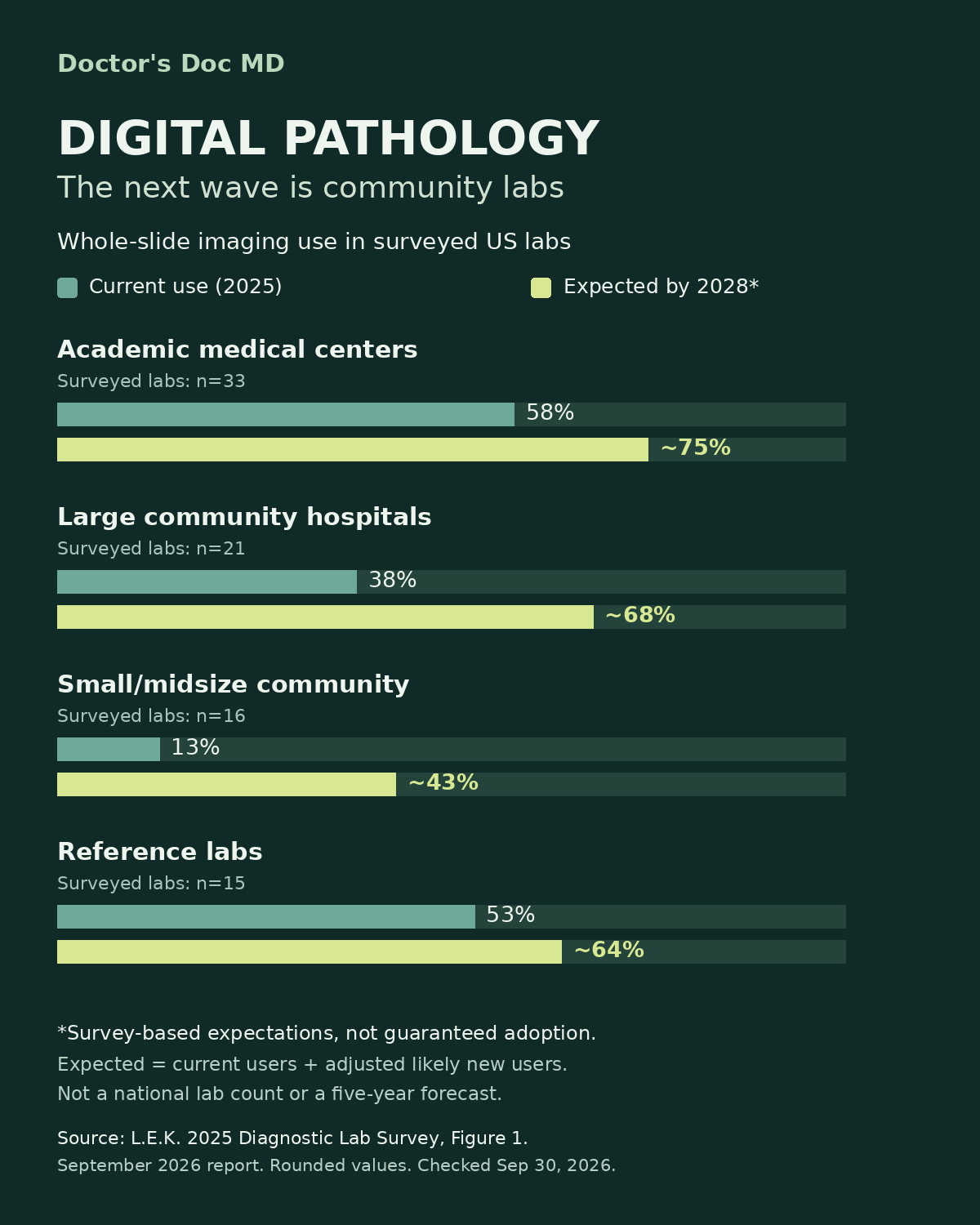
A September 2026 L.E.K. report offers a more specific outlook. In its 2025 survey, whole-slide imaging use was 38% in large community hospital labs and 13% in small/midsize community labs. Current users plus adjusted likely new adopters suggest roughly 68% and 43%, respectively, by 2028.
The chart shows all four surveyed lab groups. These are three-year survey-based expectations, not a guaranteed five-year forecast or a national count of labs.
Why go digital? Remote access and consultation, easier slide sharing and archive access, teaching and research, and better-connected workflows. A 2025 study of eight European labs reported these benefits, alongside substantial costs and integration challenges. Its findings are not a promise of savings for every lab.
Digital slides also make AI image analysis possible. FDA's Paige Prostate review included 16 pathologists and 527 slide images: assisted reads improved cancer detection on individual images by 7.3% on average. The study did not measure effects on final patient diagnosis. AI remains an adjunct to the pathologist, with tool-specific validation and appropriate clinical use.
NYU shows the workforce side: digital pathology coordinators prepare slides, check image quality and troubleshoot scanners. CAP TODAY described science-degree recruits, hands-on training and planned lead roles. New technology needs skilled people behind every image.
Sources: KLAS Digital Pathology 2026; L.E.K. 2025 Diagnostic Lab Survey (2026 report); Matias-Guiu et al., Virchows Archiv (2025), doi:10.1007/s00428-025-04064-y; FDA Paige Prostate review; CAP TODAY, February 2025.
Sources
- https://klasresearch.com/report/digital-pathology-2026-early-adoption-and-technology-performance-in-an-emerging-us-market/3711
- https://www.lek.com/sites/default/files/2026-09/digital-pathology-demand-and-adoption-trends-insights-from-lek-us-clinical-diagnostic-lab-survey-ei.pdf
- https://link.springer.com/article/10.1007/s00428-025-04064-y
- https://www.fda.gov/news-events/press-announcements/fda-authorizes-software-can-help-identify-prostate-cancer
- https://www.captodayonline.com/newsbytes-0225/
- https://nyulangone.org/news/microscopes-give-way-scanners-digital-pathology-makes-its-debut
For education only. This page does not offer personal medical advice.