
Who are the people of the lab?
Behind every tissue diagnosis: the specimen and its story
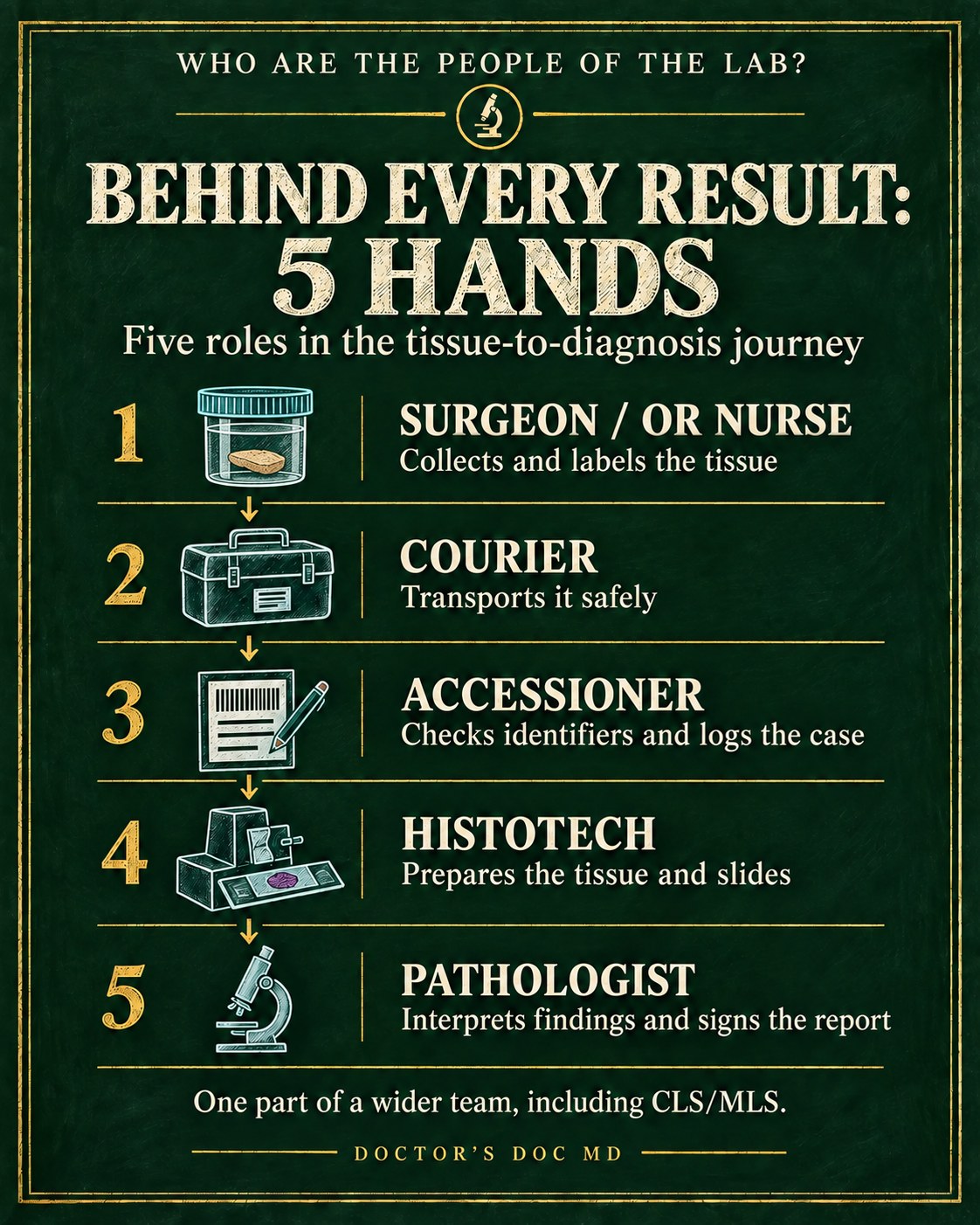
A biopsy does not arrive at the microscope with its story attached by magic.
The tissue has to travel. So does the information: whose tissue it is, where it came from, what was collected, when it was collected, and what question the clinician is asking.
Lose the tissue and there is nothing to examine. Lose its identity or context and even a beautifully prepared slide can become unreliable.
Our chalkboard shows five roles in that journey. It is a teaching map, not a complete staffing chart. Endoscopists, pathologists' assistants, grossing staff, cytology teams and many other professionals also contribute. Some roles overlap, and workflows vary.
1. SURGEON / OR NURSE: THE STORY STARTS HERE
At collection, the container and the test request need to tell the same story. Patient identifiers, the tissue site, and the specimen description connect the material to the person and procedure. If several samples are taken, each needs a clear identity of its own.
The request also carries the clinical question and relevant history. Collection and preservation times matter for some downstream tests.
What can go wrong? A label belongs to another patient. Left and right are confused. Several containers have vague descriptions that do not explain which site is which. A collection time or important clinical detail is missing.
A later barcode cannot repair an identity that was wrong at the beginning.
2. COURIER: MORE THAN MOVING A CONTAINER
The handoff includes the specimen, its request or electronic order, its destination, and any special handling information. Tracking connects pickup and receipt so the team can account for the specimen's journey.
What can go wrong? A container leaks, travels to the wrong location, is delayed, or cannot be accounted for. Special handling information does not reach the next person. The tissue arrives, but the order does not.
Time and preservation can affect what the laboratory can learn from tissue. The requirements depend on the specimen and intended testing, which is why this is not one universal transport recipe.
3. ACCESSIONER: CONNECTING THE PHYSICAL SPECIMEN TO THE RECORD
Accessioning links the container to a laboratory case. The team checks identifiers, the request, specimen sites and the number of containers, then records the case in the laboratory information system, or LIS.
The case number becomes a link across the original specimen, later tissue blocks, slides and report.
What can go wrong? Information is entered into the wrong patient record. A specimen part is omitted or assigned the wrong site. A mismatch between container and request is missed. A duplicate record splits the information into two places.
This is a checkpoint, not simply data entry.
THE GROSSING HANDOFF: PATHOLOGISTS' ASSISTANT / PATHOLOGIST
Grossing is the examination and sampling of the specimen before tissue processing. Pathologists' assistants do this work under an anatomic pathologist's direction and supervision; pathologists and other appropriately trained staff also have roles depending on the setting.
The handoff carries a gross description: what was received, its size and appearance, and which areas were selected for microscopic examination. When orientation matters, the surgeon's markings and specimen information help identify which surface is which. Inks can mark margins, with the color key recorded. A cassette is the small labeled holder for tissue pieces; the cassette key records where those pieces came from.
What can go wrong? Orientation information is missing or misunderstood. An ink color is assigned to the wrong surface or its meaning is not recorded. Sampling does not capture an area important to the clinical question. A cassette label or key points to the wrong specimen part.
Those mistakes can travel into an otherwise well-prepared slide. The pathologist needs the slide and the map that explains it. Grossing preserves that map.
4. HISTOTECH: KEEPING IDENTITY THROUGH TRANSFORMATION
Histology then turns selected tissue into prepared blocks and thin, stained sections on glass slides. The identity must remain connected through each transformation. Block and slide labels also identify the specimen part and the stain or procedure performed.
What can go wrong? A block or slide is mislabeled. Tissue from another specimen contaminates a section. Preparation or staining problems make the tissue harder to interpret. The link between a slide and its original tissue part is lost.
The goal is a readable slide whose identity and origin remain clear.
5. PATHOLOGIST: THE SLIDE IS ONLY PART OF THE ANSWER
The pathologist brings together the microscopic findings, specimen description, clinical history and any additional studies. The signed report must stay connected to the right patient and specimen, then reach the care team.
What can go wrong? A finding is interpreted without important context. A specimen site or patient detail is copied incorrectly. A report does not clearly explain its limits or pending work. Important information is not communicated to the intended clinician.
The last handoff is information, not tissue.
WHY THIS MATTERS
A safe diagnosis depends on the whole chain. Good handoffs carry three things together: the specimen, its identity and its context.
This is not about blaming one person when something goes wrong. It is about building checks that catch a mismatch before it travels farther, and learning from errors and near misses.
The people behind those checks deserve to be seen.
Which handoff in this journey do you wish more people understood?
Follow Doctor's Doc MD for more medicine explained plainly.
Educational overview, not instructions for handling an individual specimen or interpreting a personal report.
Related: Behind every blood test
Dr. Deepak Mohan, Founder, Doctor's Doc MD · #DoctorsDocMD