
Who are the people of the lab?
Behind every blood test: the tube, the data and the people
A blood test looks simple from the outside. A tube goes to the laboratory. A number comes back.
Between those two moments, people have to keep the sample and its information connected. The right test on the wrong person's blood is still the wrong result. A correct measurement sent to the wrong record is still a failure.
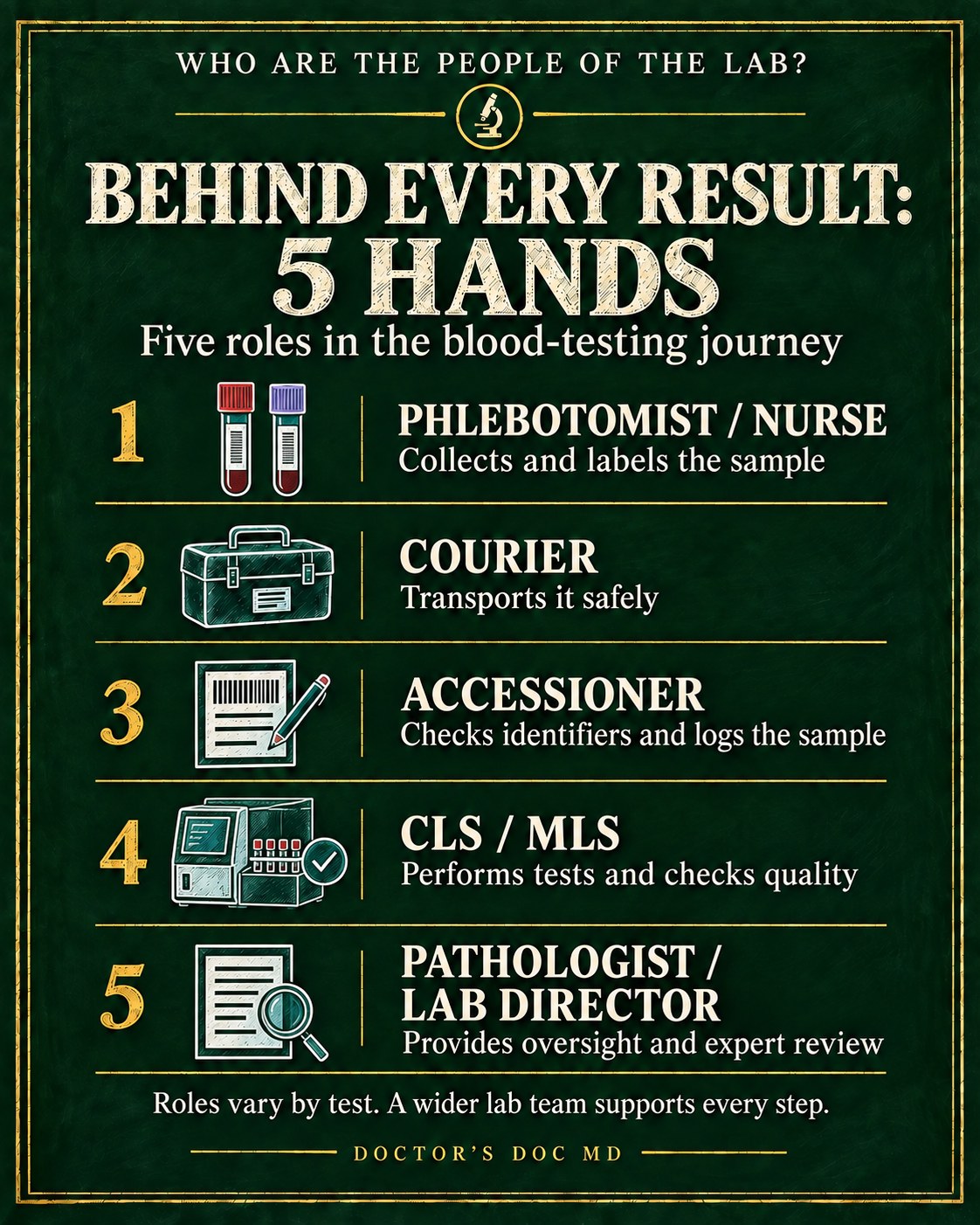
The chalkboard shows five roles, not every job involved. Roles overlap, titles vary, and different tests follow different paths. The fifth role is oversight across the system, not a claim that a pathologist personally signs every routine blood result.
1. PHLEBOTOMIST / NURSE: CONNECT THE PERSON, THE ORDER AND THE TUBE
The collection handoff carries patient identifiers, the requested tests, the collection date and time, and information about the specimen. Different tests may require different sample types, containers or handling.
What can go wrong? The tube has another patient's label. The wrong tube is used. There is too little sample for the requested testing. Required timing or preparation information is missing.
These are not cosmetic details. They affect whether the laboratory can produce a dependable answer from that sample.
2. COURIER: PROTECT THE SAMPLE AND ITS TIMELINE
Transport includes the destination, tracking information and any test-specific time or temperature requirements. The laboratory needs to know when the sample was collected and when it arrived.
What can go wrong? A tube leaks, is misplaced or goes to the wrong laboratory. Transport takes too long. Handling conditions do not match what the test requires. The order and sample become separated.
A tube can look intact even when the journey has affected its suitability for testing.
3. ACCESSIONER: MAKE THE LABORATORY RECORD MATCH THE TUBE
At receipt, the team checks the label against the order, the sample type and condition, and whether the requested information is complete. The sample receives a laboratory identity linked to the patient, order and receipt time in the laboratory information system, or LIS.
What can go wrong? Data are entered into the wrong record. The wrong test is selected. An incomplete order or label mismatch is missed. A sample unsuitable for a particular test is accepted without the required assessment.
For example, damage to red blood cells, called hemolysis, can interfere with some tests. Whether a sample can be used depends on the test and the laboratory's procedures. It is not a blanket rule for every blood test.
Accessioning is where many problems can be found before testing begins.
4. CLS / MLS: THE ANALYZER DOES NOT WORK ALONE
Clinical laboratory scientists and medical laboratory scientists perform testing, assess sample and instrument issues, and check quality. Some work uses analyzers; some requires other methods and human review.
When a sample is divided into smaller portions, those portions must remain traceable to the original tube. Results also need to stay linked to the correct sample, method and quality records.
What can go wrong? A smaller portion gets the wrong label. An instrument or reagent problem is missed. A quality-control warning is overlooked. A result is copied or transferred incorrectly.
An analyzer generates data. Trained professionals help determine whether those data can be trusted and released under the laboratory's procedures.
5. PATHOLOGIST / LAB DIRECTOR: OVERSIGHT, REVIEW AND COMMUNICATION
The pathologist or laboratory director helps oversee the testing system and provides expert review when needed. Result review and release also involve qualified laboratory staff under the laboratory's procedures; routine results do not all wait for a pathologist's individual signature.
The final information handoff includes the patient identity, test result, units, reference interval where applicable, relevant comments and the intended recipient. Urgent or critical findings may need a separate communication process. Corrected reports need a clear record of what changed.
What can go wrong? The value reaches the wrong patient chart. Units or reference information are missing or incorrect. An important result is released but does not reach the responsible care team. A correction fails to reach someone who saw the original report.
A technically sound measurement is not enough if the communication fails.
THE NUMBER IS THE END OF A CHAIN
Laboratory quality includes what happens before testing, during testing and after testing.
Good handoffs keep the sample, its identity and its information together. Checks are there to catch problems, not to suggest that any one role is untrustworthy. Errors and near misses are opportunities to improve the system, not excuses to blame the last person who touched the tube.
Which part of this journey deserves more recognition?
Follow Doctor's Doc MD for more medicine explained plainly.
Educational overview, not instructions for collecting samples or interpreting an individual's test results.
Related: Behind every tissue diagnosis
Dr. Deepak Mohan, Founder, Doctor's Doc MD · #DoctorsDocMD