
Weber et al. · The Lancet 2024 | Khattak et al. · JCO 2026 | Dr. Mohan's take
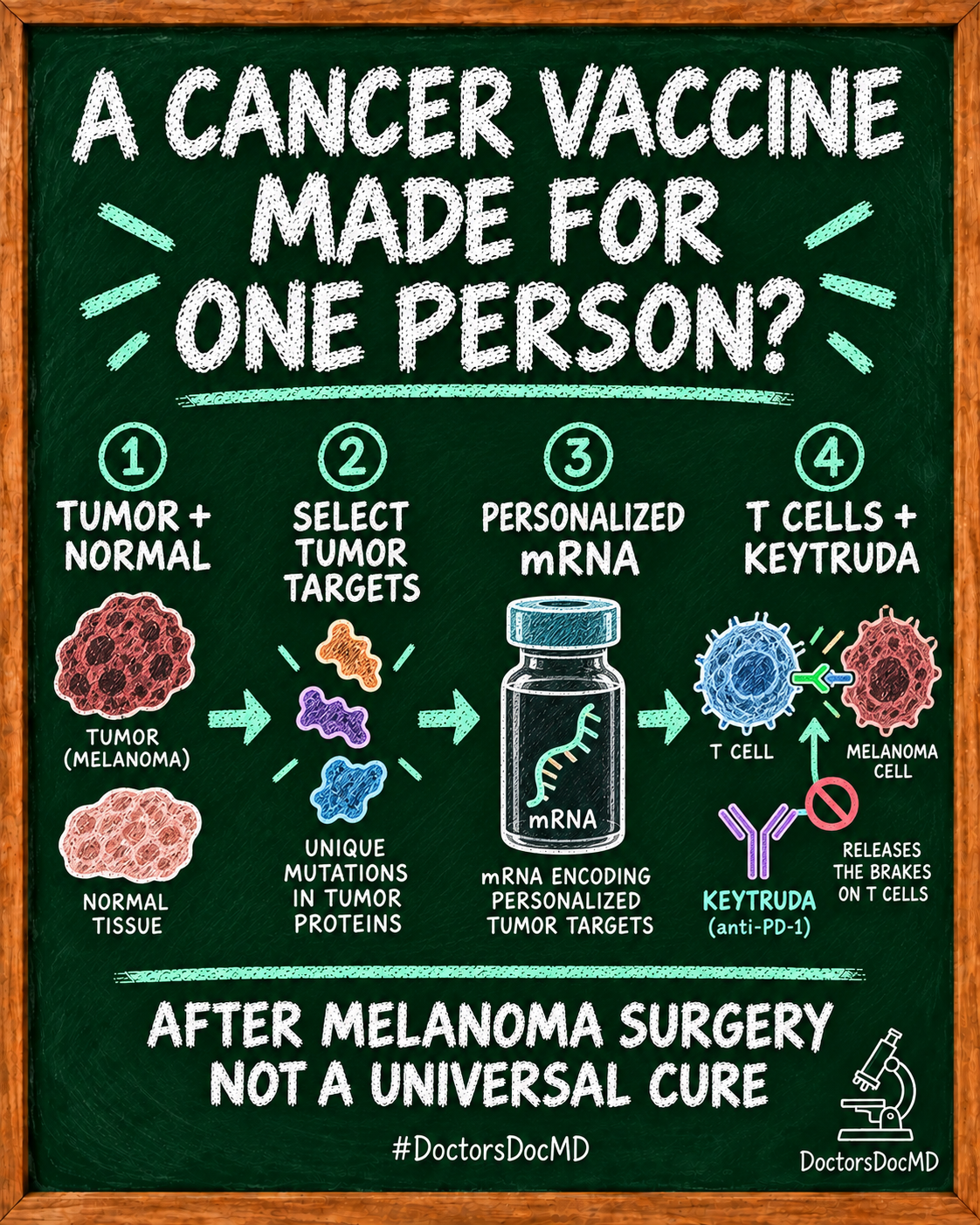
"Cancer vaccine" sounds like something healthy people get to prevent cancer. This one is different. It is made after melanoma has been diagnosed and surgically removed, with the aim of helping the immune system find cells that remain. Keytruda is not the vaccine. It is the checkpoint-blocking drug used in both arms of this trial.
The researchers sequence tumor tissue and compare its mutations with the patient's normal tissue. They select likely immune-visible tumor changes, called neoantigens, and encode up to 34 of them in mRNA. The patient's cells read that temporary molecular instruction and display the target proteins; immune T cells may learn to recognize them. Pembrolizumab blocks PD-1, one of the brakes on T cells. The idea is to teach the immune system what to look for and release a brake on its response. That mechanism is plausible, but clinical outcomes, not a diagram, determine whether the combination helps.
In KEYNOTE-942, 157 people with completely resected high-risk stage IIIB-IV cutaneous melanoma were randomly assigned: 107 to individualized mRNA treatment plus pembrolizumab and 50 to pembrolizumab alone. This was an open-label phase 2b study, not a trial of the vaccine alone and not a trial in every cancer. Its primary outcome was recurrence-free survival, the time without the melanoma returning or death. In the original Lancet report, recurrence or death occurred in 22% of combination patients versus 40% of pembrolizumab-only patients; estimated 18-month recurrence-free survival was 79% versus 62%. The hazard ratio was 0.561 (95% CI 0.309-1.017), with a two-sided p=.053. The study used a prespecified phase 2b statistical threshold less stringent than the conventional .05; the initial 95% confidence interval crossed 1. That is a reason to describe an encouraging signal, not certainty or a 44% absolute reduction in risk. Grade 3 or higher treatment-related events occurred in 25% versus 18%.
A peer-reviewed five-year update in JCO followed the same phase 2b group for a median 60.3 months. Its descriptive estimates favored the combination for recurrence-free survival (HR 0.510, 95% CI 0.294-0.887) and distant metastasis-free survival (HR 0.411, 95% CI 0.200-0.843). Overall survival showed a favorable trend, but its interval was wide and crossed 1 (HR 0.471, 95% CI 0.165-1.345), so this has not established that people live longer. These are relative time-to-event hazards, not the percent of people cured. The investigators saw expanded novel T-cell clonotypes, supporting the proposed biology, though that finding does not prove mechanism in an individual patient.
What changed since the papers: in August 2026, Merck and Moderna announced that the 1,137-person, blinded phase 3 INTerpath-001 trial met its recurrence-free and distant-metastasis-free survival endpoints at an interim analysis, in resected stage IIB-IV melanoma. This is important but currently a company topline release, not a detailed peer-reviewed phase 3 result in the sources checked. The release does not provide a phase 3 hazard ratio or absolute benefit, and overall survival follow-up continues. Do not reuse the phase 2b "49%" figure as a phase 3 result. The vaccine remains investigational, and patients should discuss actual options with their oncology team.
Papers and context: Weber et al. Lancet 2024, DOI 10.1016/S0140-6736(23)02268-7; Khattak et al. JCO 2026, DOI 10.1200/JCO-26-00835; phase 3 trial registration; Aug 2026 sponsor announcement.
Educational commentary, not personal medical advice. The vaccine remains investigational. Sources and dates appear above.
← More from the Reading Room